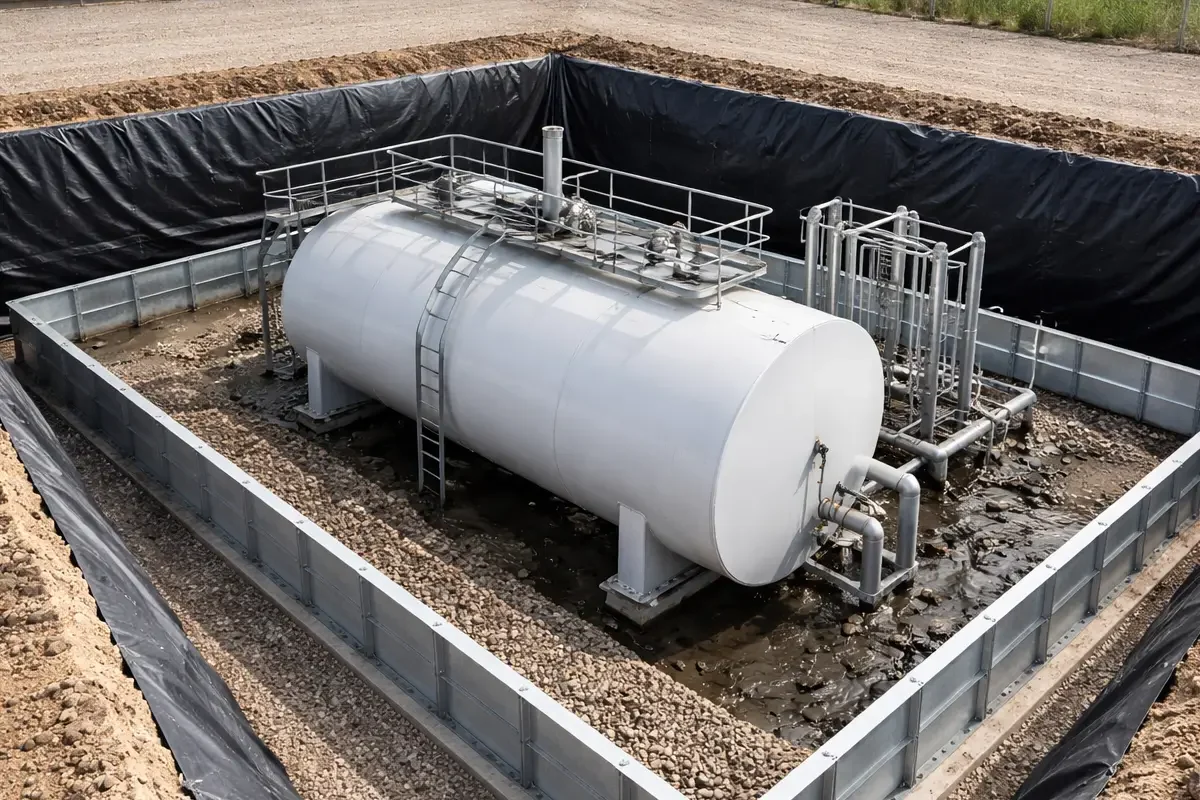
Quick, Safe, and Hassle-Free Holding Tank Installation
The Stormwater Tanks Australian anti-floatation base and extra heavy-duty rating make the 10,000 and 20,000-litre fuel spill tanks ideal for service stations and fuel depots. With hydrocarbon-resistant coatings, they ensure long-lasting protection and compliance.
Our tanks are easy, safe, and fast to install under driveway areas. The T44 Extra Heavy Duty rating allows heavy trucks to pass over safely, even when tanks are empty. Stormwater Tanks Australian coated spill tanks are trusted by Puma, Caltex, and 7-Eleven.
The full range can also be coated for chemical spill tanks, wash bays, and cooling pits.
All Stormwater Tanks Australian tanks and pump stations are engineered with anti-floatation design. Once backfilled, they can be installed in full saturation without causing hydrostatic uplift to the slab above.
For challenging conditions such as basements, tidal zones, or flood-prone areas, certain models can withstand over 3.0m water cover while maintaining zero buoyancy. By selecting the right tank for the water table, installers avoid complex ballast calculations and eliminate the need for extra project management with concrete or water trucks.
Stormwater Tanks Australian manufactures all products using 50MPa strength concrete, delivering exceptional durability and compressive strength for heavy-duty applications. This high-grade concrete ensures long service life, even under extreme loads and harsh environmental conditions.
By using 50MPa concrete, our tanks maintain structural integrity, resist cracking, and provide superior performance in critical installations such as fuel depots, industrial sites, and flood-prone areas. Customers can rely on Stormwater Tanks Australian for tanks engineered to meet strict safety and durability standards.
All Stormwater Tanks Australian products are built to a B2 exposure classification, meeting the requirements of Australian Standard AS3735 for concrete structures designed to retain liquids. This guarantees that every tank is manufactured to withstand aggressive conditions, including constant exposure to water, chemicals, and varying soil environments.
The B2 rating provides assurance of long-term durability, resistance to corrosion, and structural reliability in demanding applications. Whether installed in industrial, commercial, or high-risk environments, Stormwater Tanks Australian tanks are engineered to perform safely and effectively over decades of use.