
Fuel storage is an essential part of many industrial, commercial, agricultural, mining, transport, and infrastructure operations. However, storing and transferring fuel also creates environmental and workplace risks.
Leaks, equipment failures, overfilling, damaged pipework, and transfer incidents can release fuel into the surrounding area. Once released, fuel can reach soil, groundwater, waterways, or stormwater drainage systems.
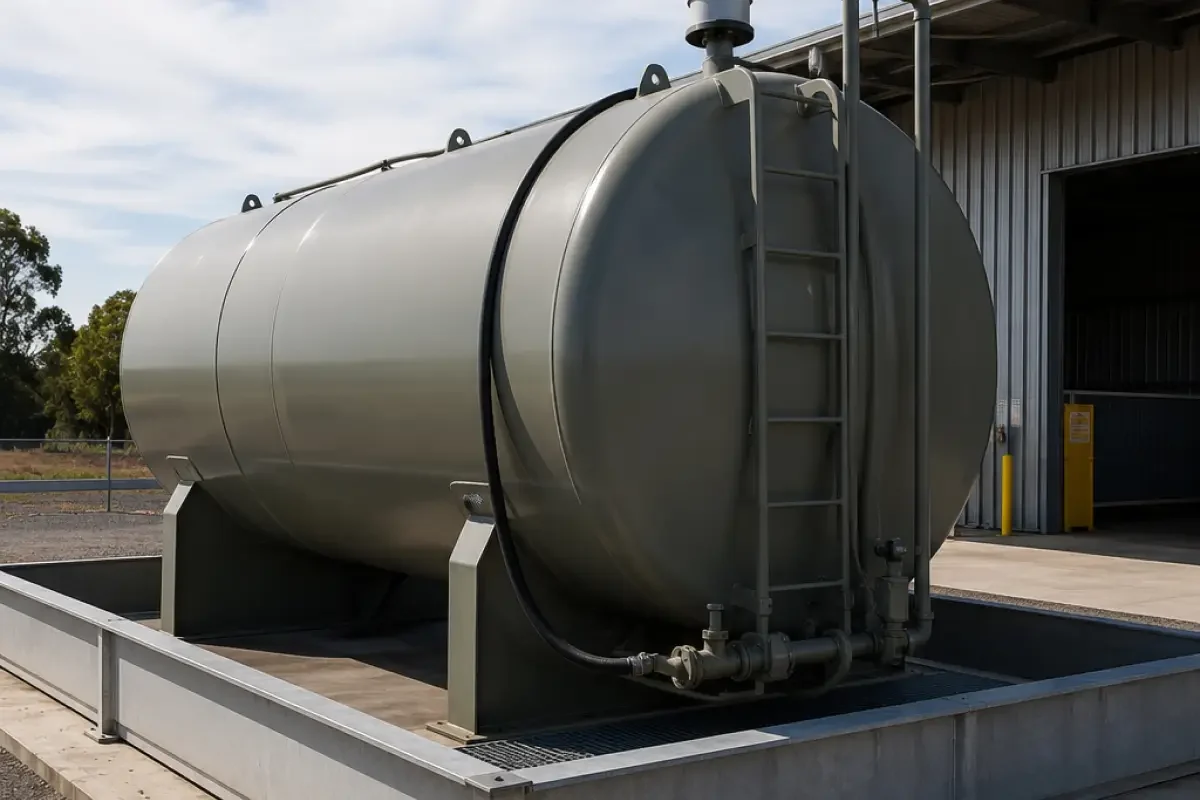
A fuel spill containment tank provides a controlled location for capturing fuel or contaminated liquids following a spill or leak. Depending on the system, containment may be integrated with fuel storage or installed as separate secondary containment.
Fuel spill containment forms part of a broader risk-management system. It can work alongside bunds, double-walled tanks, spill sumps, drainage controls, alarms, and emergency response procedures.
This guide explains fuel spill containment tanks, how they work, available types and materials, and their main benefits. It also covers selection, maintenance, inspections, and key Australian regulatory considerations.
What is a Fuel Spill Containment Tank?
A fuel spill containment tank is a tank or containment system designed to capture fuel that escapes from its primary storage or handling system.
Its purpose is different from the primary fuel tank. The primary tank holds fuel during normal operation. Secondary containment provides another barrier when fuel escapes unexpectedly.
Australian guidance describes secondary containment as equipment or infrastructure designed to contain leaks and prevent petroleum escaping beyond the containment area. Double-walled tanks and piping are examples.
Fuel containment systems can be used to manage releases from:
- storage tanks;
- fuel transfer areas;
- pipework;
- pumps;
- filling points;
- dispensing areas;
- loading and unloading operations;
- associated equipment.
The exact design depends on the volume and type of fuel being handled.
Why is Fuel Spill Containment Important?
Even a relatively localised fuel spill can create significant problems. Fuel can migrate through soil and potentially reach groundwater. Surface spills may also enter stormwater drains and nearby waterways.
This creates environmental, operational, safety, and financial risks. NSW EPA guidance recommends storing fuels and other hazardous liquids in designated areas away from stormwater drains. Suitable areas should generally be sealed, covered, and bunded where appropriate.
Effective containment can help:
- prevent spills spreading across a site;
- reduce the risk of soil contamination;
- protect groundwater;
- protect stormwater systems;
- simplify spill recovery;
- reduce environmental exposure;
- support emergency response;
- meet applicable site and regulatory requirements.
Containment does not prevent every spill. Instead, it limits what can happen after primary containment fails.
How Does a Fuel Spill Containment System Work?
A containment system creates a controlled secondary barrier around or downstream from potential fuel release points. The principle is straightforward.
Fuel is normally held within primary storage. If a leak or spill occurs, the secondary system captures the escaping liquid. The fuel remains contained until it can be safely recovered, treated, or disposed of.
A system may use:
- a secondary tank;
- a double-walled tank;
- a bund;
- a containment sump;
- drainage channels;
- collection pits;
- shut-off valves;
- impervious surfaces.
Some sites combine several methods. Safe Work Australia guidance recognises bunding, graded surfaces, secure catchment pits, ponds, and combinations of these systems as possible spill-containment approaches.
The best design depends on the site’s specific hazards.
Primary vs Secondary Fuel Containment
Understanding this distinction is important when planning fuel storage. Primary containment is the equipment normally holding the fuel.
Examples include:
- fuel tanks;
- drums;
- intermediate bulk containers;
- pipework;
- process vessels.
Secondary containment provides backup if primary containment fails.
Examples include:
- spill containment tanks;
- bunded compounds;
- double-skinned tanks;
- containment sumps;
- lined containment areas.
The two systems perform different roles.
A high-quality fuel tank reduces the likelihood of leakage. Secondary containment reduces the consequences if leakage still occurs.
Where are Fuel Spill Containment Tanks Used?
Fuel containment requirements vary considerably between facilities. These systems may be relevant wherever significant quantities of fuel are stored, handled, or transferred.
Applications can include:
- industrial facilities;
- mines;
- farms;
- transport depots;
- warehouses;
- construction sites;
- airports;
- ports and marinas;
- service stations;
- workshops;
- power facilities;
- government facilities;
- remote infrastructure sites.
Underground petroleum storage systems are also used beyond service stations. NSW EPA identifies locations including marinas, airports, work depots, car dealerships, and government facilities.
The containment approach should reflect the actual site rather than the industry label alone.
Types of Fuel Spill Containment Systems
There is no single containment tank suitable for every fuel storage application. Several systems can provide secondary containment.
Dedicated Spill Containment Tanks
A dedicated containment tank receives fuel or contaminated liquids following a spill. It may be connected to drainage or collection infrastructure.
These systems can be useful where spills need to be directed away from operational areas into secure storage. Tank capacity should reflect the reasonably foreseeable spill volume and site-specific requirements.
Double-Walled Fuel Tanks
Double-walled tanks contain an inner and outer wall. The inner tank provides primary containment. The external wall creates an additional barrier.
The space between the two walls is known as the interstitial space. This arrangement can help contain leakage from the primary tank. Depending on the system, the interstitial space can also support leak detection.
Self-Bunded Fuel Tanks
Self-bunded tanks integrate primary and secondary containment within one storage system. They can be useful where constructing a separate external bund is impractical.
However, integrated containment does not remove the need for inspection and maintenance. The complete tank and its containment system still require monitoring.
Bunded Fuel Storage Areas
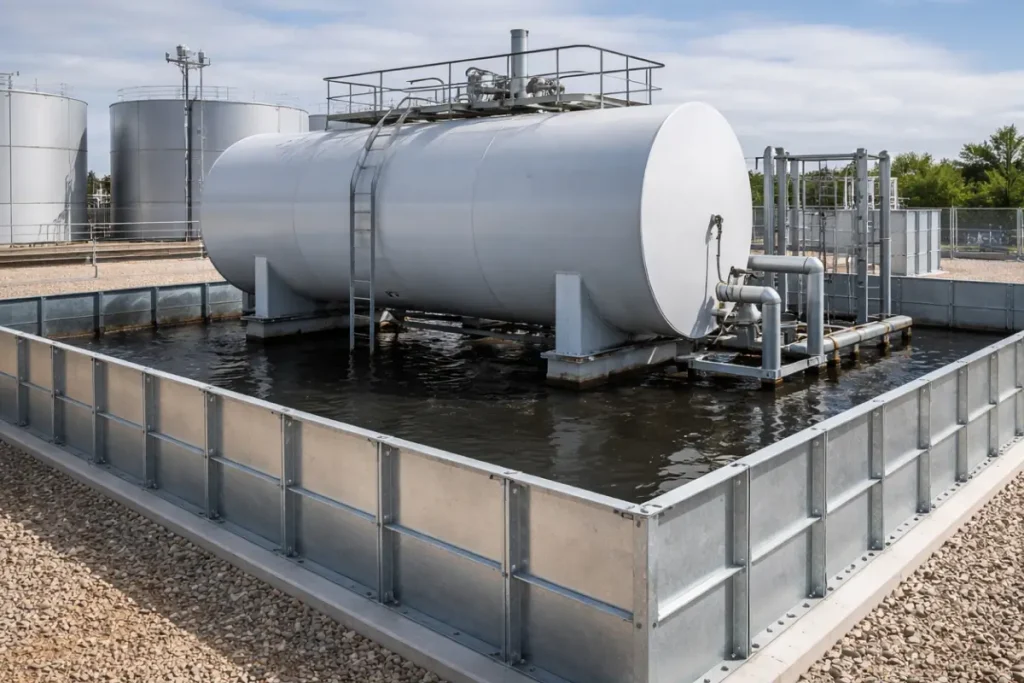
Bunding remains one of the most common fuel spill containment approaches. A bund creates an impermeable barrier around a storage area.
If fuel escapes, the bund prevents it spreading beyond the designated containment zone. WorkSafe Victoria describes bunding as the most commonly used system for containing fuel spills around above-ground fuel tanks.
Bunds can be constructed using concrete, compacted earth, or other suitable materials.
Spill Sumps and Collection Pits
Smaller containment areas can direct spilled fuel toward a sump or collection pit. These systems can be particularly useful around transfer or dispensing points.
The collected liquid can then be recovered. Sumps should remain accessible for inspection and removal of accumulated liquids.
Underground Secondary Containment
Underground fuel storage introduces different risks because leakage may remain invisible at the surface. Secondary containment can include double-walled tanks and pipework with interstitial spaces.
Monitoring becomes particularly important. NSW requirements for underground petroleum storage systems include measures to detect and address fuel losses before they create larger contamination problems.
What Materials are Fuel Spill Containment Tanks Made From?
Material compatibility is critical. The containment material must tolerate the fuel or other hazardous liquid it may receive.
Safe Work Australia specifically identifies material compatibility as a factor when designing spill containment.
Steel
Steel provides significant structural strength and is widely used for fuel storage equipment. Different steel systems may use protective coatings or specialised construction to improve corrosion resistance.
Steel containment can suit demanding industrial environments. However, corrosion remains an important consideration.
External exposure, trapped moisture, damaged coatings, and site conditions can all affect performance.
Stainless Steel
Stainless steel provides strong corrosion resistance for appropriate applications. It can be selected where environmental conditions or chemical compatibility require greater resistance.
Its higher initial cost may limit its use in some projects.
Polyethylene
Suitable polyethylene products can provide good chemical resistance and relatively low weight. They are commonly used in various chemical containment applications.
However, not every polyethylene grade is compatible with every fuel or chemical. Material specifications should always be checked against the intended liquid.
Fibreglass and FRP
Fibreglass-reinforced plastic can be used for some storage and containment applications. FRP offers corrosion resistance and can be manufactured for different environments.
The resin system is particularly important. Chemical compatibility depends on the complete material system rather than simply describing the tank as fibreglass.
Concrete
Concrete is commonly used for larger bunds, pits, and containment structures. It provides structural strength and can form part of permanent site infrastructure.
However, untreated concrete should not automatically be considered impermeable to every fuel. Appropriate lining, sealing, or surface protection may be required.
NSW EPA guidance states that bunded containment should be impermeable to the liquid being stored.
Fuel Spill Containment Tanks vs Bunds
Both approaches provide secondary containment, but they work differently. A containment tank provides a dedicated enclosed storage volume. A bund creates a contained area around primary storage equipment.
Bunds can be highly effective for above-ground tanks and multiple-container storage areas. Dedicated tanks can be useful where spills are directed through drainage infrastructure into a controlled collection point.
The choice can depend on:
- available space;
- primary tank configuration;
- spill volume;
- drainage design;
- environmental risk;
- fuel type;
- transfer activities;
- site layout;
- maintenance requirements.
Some facilities use both. A bund can capture the initial release while drainage directs liquids toward another containment system.
Fuel Spill Containment vs General Chemical Containment
Fuel containment is one category of hazardous liquid containment. General chemical containment systems may need to manage acids, solvents, oils, process chemicals, or other substances.
The underlying principle remains similar. The system should prevent uncontrolled release into the surrounding environment.
However, materials cannot automatically be shared between applications. A containment system suitable for diesel may not be suitable for a highly corrosive chemical. Safe Work Australia guidance also notes that incompatible hazardous chemicals should have separate containment where mixing could create additional hazards.
Chemical compatibility should therefore be assessed before choosing the containment system.
Fuel Spill Containment vs Firewater Containment
Fuel containment and firewater containment also serve different purposes. Fuel containment primarily captures spilled or leaking fuel. Firewater containment manages potentially contaminated water generated during firefighting.
A major incident can involve both. Firefighting water may mix with fuel, chemicals, foam, or other contaminants. This can significantly increase the required containment volume.
Safe Work Australia identifies firefighting water as one factor that may need consideration when sizing hazardous chemical containment.
High-risk sites should therefore consider emergency scenarios rather than normal storage volumes alone.
Fuel Spill Containment vs Stormwater Detention
These systems should not be confused. Stormwater detention temporarily stores relatively uncontaminated rainfall runoff before controlled discharge. Fuel spill containment prevents hazardous liquids from escaping into the environment.
Allowing contaminated fuel runoff to enter a normal stormwater system can create serious environmental consequences. NSW EPA guidance specifically recommends keeping fuels and hazardous liquids away from stormwater drains and using suitable containment.
Sites storing fuel may also use stormwater cut-off valves to prevent contaminated runoff leaving the property during an incident.
Key Benefits of Fuel Spill Containment Tanks
A well-designed containment system provides several practical advantages.
Environmental Protection
Fuel can contaminate soil, groundwater, and waterways. Secondary containment helps keep a release within a controlled area.
Faster Spill Response
Contained fuel is generally easier to recover than fuel spread across a large site. This can support faster clean-up and reduce the affected area.
Reduced Contamination Risk
Preventing fuel from reaching soil can reduce the risk of extensive remediation requirements.
Protection of Stormwater Infrastructure
Containment can prevent fuel entering pits, drains, and downstream waterways.
Operational Risk Management
Containment forms part of broader emergency and environmental planning. It gives facility operators another level of protection when primary systems fail.
Regulatory Compliance
Suitable containment can help facilities meet applicable dangerous goods and environmental obligations. However, the exact requirements depend on location, fuel type, storage quantity, and facility design.
How Much Capacity does Fuel Spill Containment Need?
There is no universal containment volume that should be applied to every Australian site. Capacity depends on the application and relevant regulatory requirements.
Safe Work Australia recommends considering:
- the hazardous chemical involved;
- total quantity;
- largest container;
- reasonably foreseeable spill;
- environmental consequences;
- possible firefighting water;
- chemical compatibility.
Some guidance uses specific bund capacity formulas. For example, NSW EPA general stormwater guidance recommends a bund large enough for the largest container plus 10%.
However, this should not be treated as a universal design rule. Different dangerous goods classes, storage arrangements, jurisdictions, and Australian Standards can require different approaches.
Containment capacity should be established for the actual facility.
How to Choose the Right Fuel Spill Containment Tank
Selecting a containment system begins with understanding the risk.
Identify the Fuel
Determine exactly what will be stored or potentially captured. Diesel, petrol, oils, and other petroleum products can have different hazards and requirements.
Determine the Potential Spill Volume
Consider both total storage and the largest reasonably foreseeable release. Transfer operations should also be included.
Safe Work Australia notes that transferring hazardous chemicals can present greater risks than static storage.
Assess Material Compatibility
The tank, liner, seals, pipework, and other components should be compatible with the fuel. This should be confirmed through appropriate specifications.
Consider the Location
Above-ground and underground systems have different design requirements. Ground conditions, traffic, drainage, flood risk, and nearby infrastructure may influence the choice.
Review Site Drainage
Identify nearby stormwater pits and drainage paths. A containment system should not create a pathway for fuel to escape into stormwater.
Consider Access
The system will eventually require inspection, cleaning, or repairs. Access should be considered during design rather than after installation.
Review Emergency Scenarios
Think beyond normal operation. Overfilling, pipe failure, delivery incidents, fires, and equipment damage may create larger releases.
Check Applicable Requirements
Australian requirements vary according to jurisdiction and the quantities and classes of dangerous goods stored. The applicable standards and regulations should be confirmed for the specific project.
Fuel Spill Containment Tank Inspection
Regular inspection is important because containment only works when it remains available and intact. A containment tank or bund may appear unused for long periods.
However, damage can develop while the system is waiting for an emergency.
Inspection can include checking:
- walls and surfaces;
- corrosion;
- cracking;
- liners;
- seals;
- valves;
- drainage components;
- sumps;
- penetrations;
- alarms;
- leak detection systems;
- accumulated liquids;
- debris.
Any defect that compromises containment should be investigated. Inspection records also create evidence of ongoing condition and maintenance.
Fuel Spill Containment Tank Maintenance
Maintenance keeps the system ready for use. A bund filled with rainwater has less capacity available for an actual fuel spill. Similarly, debris can block drainage or collection points.
NSW EPA states that bunds should remain free of solids and liquids that reduce available containment capacity. WorkSafe Victoria similarly advises keeping fuel bunding clean and clear of debris and excess water.
Maintenance can include:
- removing accumulated rainwater appropriately;
- clearing debris;
- checking valves;
- repairing damaged surfaces;
- maintaining liners;
- testing alarms;
- checking leak detection;
- maintaining drainage controls;
- documenting repairs.
Any removed liquid should be managed appropriately rather than automatically discharged into stormwater.
Common Fuel Containment Problems
Several issues can reduce containment performance.
These include:
- corrosion;
- cracking;
- damaged liners;
- failed seals;
- blocked drains;
- open valves;
- accumulated rainwater;
- sediment or debris;
- damaged pipe connections;
- inadequate capacity;
- incompatible materials;
- poor access;
- failed leak detection.
Some problems develop gradually.
Others result from impact, equipment changes, or poor maintenance.
Routine assessment helps identify these issues before an actual spill tests the system.
What Happens if Fuel Containment Fails?
Failure can allow fuel to spread beyond the designated storage area.
Depending on the site, fuel may reach:
- soil;
- groundwater;
- stormwater;
- surface water;
- neighbouring properties;
- operational areas.
The consequences can include environmental damage, business interruption, clean-up costs, remediation, and regulatory action. Underground petroleum leaks can be particularly difficult because contamination may spread before becoming visible.
NSW EPA requires responsible operators of regulated underground petroleum storage systems to have procedures for detecting and fixing leaks promptly.
Secondary containment should therefore be treated as active risk-control infrastructure.
Australian Regulations and Standards
Fuel spill containment in Australia is governed through a combination of workplace safety requirements, environmental legislation, state regulations, Australian Standards, and site-specific obligations.
One important standard is AS 1940:2017 – The storage and handling of flammable and combustible liquids. WorkSafe Victoria references this standard for above-ground fuel storage and associated safety requirements.
Safe Work Australia guidance also states that bunding for large quantities of hazardous chemicals should be designed according to the relevant Australian Standard.
Requirements can differ between jurisdictions. Facility owners should therefore avoid relying on a single generic containment rule.
The correct requirements depend on:
- state or territory;
- fuel type;
- quantity;
- storage configuration;
- above-ground or underground installation;
- site activities;
- environmental risk;
- applicable licences;
- relevant Australian Standards.
Professional advice may be required when determining compliance for a specific facility.
The Role of Spill Response Planning
Containment infrastructure is only one part of spill management. Personnel also need to know what happens when fuel is actually released.
Sites may need suitable procedures for:
- stopping the source;
- isolating drainage;
- containing the release;
- recovering fuel;
- using spill kits;
- managing contaminated materials;
- reporting incidents;
- contacting emergency services;
- documenting the event.
WorkSafe Victoria advises keeping equipment and materials for cleaning fuel spills accessible on farms storing above-ground fuel. The containment tank therefore supports the emergency plan rather than replacing it.
Final Thoughts
Fuel spill containment tanks provide an important secondary barrier when primary fuel storage or handling systems fail. Their role is not to prevent every leak. Instead, they help stop escaped fuel from spreading into surrounding soil, groundwater, stormwater, and operational areas.
Different containment approaches are available. These include dedicated tanks, double-walled systems, self-bunded tanks, external bunds, sumps, and underground secondary containment. The correct solution depends on the fuel, potential spill volume, storage arrangement, site conditions, and regulatory requirements.
Material selection is equally important. The containment system must remain compatible with the liquid it is expected to hold. Containment also requires ongoing management.
Regular inspections can identify corrosion, cracking, damaged liners, blocked components, and other defects. Maintenance keeps the available containment volume ready for an actual incident.
Australian facilities must also consider applicable environmental legislation, dangerous goods requirements, and relevant standards such as AS 1940.
Together, these measures can reduce the consequences of fuel spills and support safer long-term fuel storage.
