

Stormwater tanks are designed to respond to rainfall events, capturing and managing runoff during periods of heavy precipitation. However, for much of the year—especially in dry or intermittent climates—these systems remain inactive. While inactivity may appear harmless, the conditions inside stormwater tanks during idle periods can quietly influence long-term performance, structural integrity, and environmental outcomes.
Understanding what happens inside stormwater systems during inactivity helps asset owners, engineers, and facility managers better anticipate risks that are not immediately visible.
Why Stormwater Tank Inactivity is More Common than Expected
Stormwater infrastructure is typically sized for peak rainfall scenarios rather than continuous operation. In many regions, rainfall events are infrequent, seasonal, or highly variable. As a result, tanks may sit partially filled or completely empty for extended periods between storm events.
During these idle phases, the system is no longer operating under its intended hydraulic conditions. Instead, internal environments become static, allowing physical, chemical, and biological processes to develop unnoticed.
Internal Conditions During Inactive Periods
When water movement slows or stops, several changes can occur inside stormwater tanks:
- Stagnant water zones may form in low-flow areas
- Temperature stratification can develop, especially in underground systems
- Reduced oxygen levels may occur in trapped water pockets
- Surface moisture and condensation can persist even when tanks appear empty
These conditions do not necessarily cause immediate failure, but over time they can contribute to material stress, microbial activity, and hidden degradation.
Structural Implications of Prolonged Inactivity
Stormwater tanks are engineered to withstand fluctuating loads. However, long idle periods can introduce stress patterns different from those experienced during active use.
For example, repeated cycles of drying and re-wetting may affect joints, liners, and connection points. In underground installations, surrounding soil moisture can continue exerting external pressure even when internal water levels remain low. Over time, this imbalance can accelerate wear in specific areas of the structure.
In lined systems, inactivity may also allow liners to relax, fold, or shift slightly—changes that are rarely visible without internal inspection.
Environmental and Water Quality Considerations
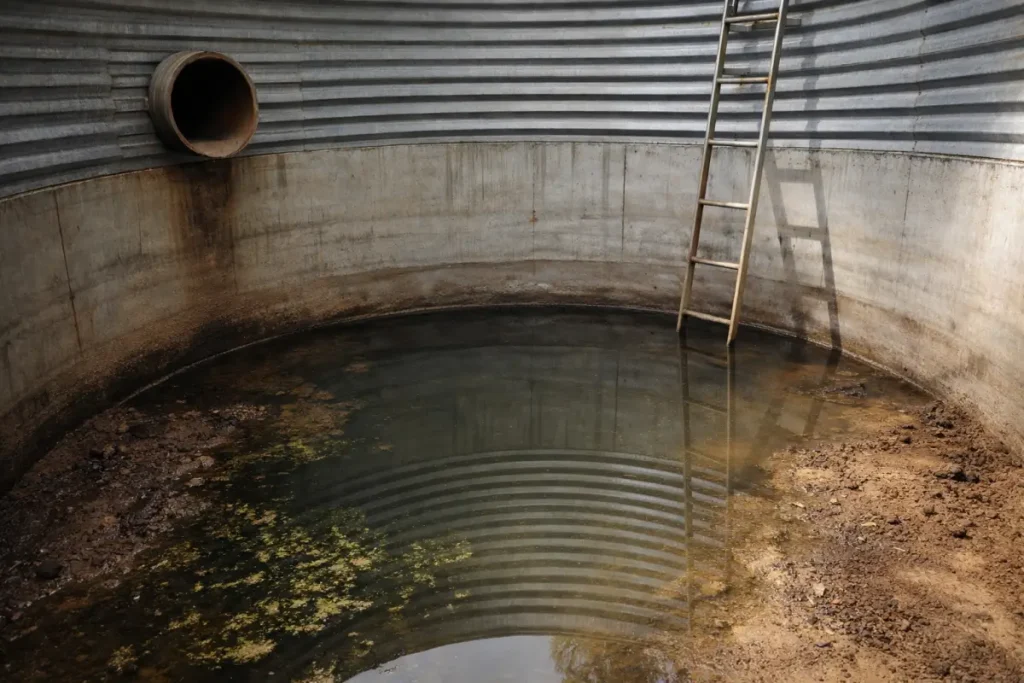
Even when stormwater tanks are not actively receiving runoff, residual water, sediments, or organic material often remain inside the system. During inactivity, these remnants can interact in ways that affect water quality once the next storm event occurs.
Without regular flushing or turnover, contaminants may concentrate in localized zones. When rainfall resumes, these accumulated materials can be mobilised rapidly, potentially impacting downstream waterways or treatment components.
This is particularly relevant in urban and industrial environments, where stormwater often carries hydrocarbons, fine sediments, and dissolved pollutants.
Why Inactivity Risks Often Go Unnoticed
One of the biggest challenges with stormwater tank inactivity is visibility. Because tanks are designed to operate only during rainfall, extended idle periods are often perceived as normal or even desirable.
Unlike mechanical systems that fail when inactive, stormwater infrastructure can degrade quietly. External signs are rare, and internal changes typically remain hidden until performance declines or inspections are conducted.
This makes inactivity-related issues easy to overlook during routine asset management planning.
Managing Stormwater Systems with Inactivity in Mind
Acknowledging inactivity as a normal operating condition allows for better long-term system management. Rather than focusing solely on peak storm performance, asset owners benefit from considering how tanks behave during the majority of their lifecycle—when little or no flow is present.
Monitoring internal conditions, understanding site-specific rainfall patterns, and recognising how materials respond to prolonged idle periods all contribute to more resilient stormwater infrastructure.
Stormwater tanks do not fail simply because they are inactive. Instead, it is the cumulative effect of repeated idle periods, combined with environmental exposure and material response, that shapes long-term performance.
