

Stormwater storage systems are designed to manage runoff, reduce flooding risk, and protect downstream waterways. While these systems are engineered with defined storage capacities, their internal behaviour changes gradually over time. One of the most common and least visible processes affecting performance is the accumulation of sediment and debris.
This buildup is not the result of a single event. Instead, it develops slowly as part of normal stormwater movement through urban and industrial catchments.
Why Sediment Accumulation is Unavoidable
Sediment accumulation is a natural outcome of stormwater runoff. Rainwater flowing across roads, roofs, landscaped areas, and construction zones picks up fine particles, organic matter, litter, and debris. Once transported into storage systems, these materials do not remain evenly suspended.
As water velocity changes, heavier particles begin to settle. Over time, this process leads to gradual buildup within stormwater storage structures, regardless of their size or configuration.
How Runoff Transports Sediment and Debris
The composition of stormwater runoff depends heavily on the surrounding environment. Urban surfaces contribute fine sediments, hydrocarbons, tyre residue, and litter, while landscaped areas introduce soil particles and organic material.
During rainfall events, runoff enters stormwater systems with varying energy levels. High-energy inflows carry suspended material deeper into the system, while lower-energy flows allow particles to settle closer to entry points. This variation creates uneven deposition patterns inside storage structures.
Flow Behaviour Inside Stormwater Storage Systems
Once runoff enters a stormwater storage system, flow velocity decreases significantly. These systems are designed to slow water movement to allow temporary storage and controlled release. While this is effective for flood management, reduced velocity also encourages sediment settling.
Changes in flow direction, internal geometry, and water depth create zones where water movement becomes minimal. These low-energy zones act as natural collection points for sediment and debris.
Low-Flow Zones and Settling Patterns
Sediment rarely accumulates uniformly across a stormwater storage system. Instead, it tends to concentrate in areas where water movement is weakest. Corners, base sections, and areas downstream of inflow points often experience higher deposition rates.
Over repeated rainfall events, these zones continue to collect material even when external conditions appear unchanged. Because the accumulation process is gradual, it often remains unnoticed for long periods.
The Influence of Catchment Characteristics
The rate and composition of sediment accumulation are strongly influenced by catchment conditions. Construction activity, road density, land slope, and surface materials all affect the amount and type of debris entering stormwater systems.
Urban catchments with high impervious surface coverage typically generate runoff with higher concentrations of fine sediments and pollutants. Industrial areas may contribute heavier particulate matter, while green spaces introduce organic debris that behaves differently during settling.
How Accumulation Affects Effective Storage Capacity
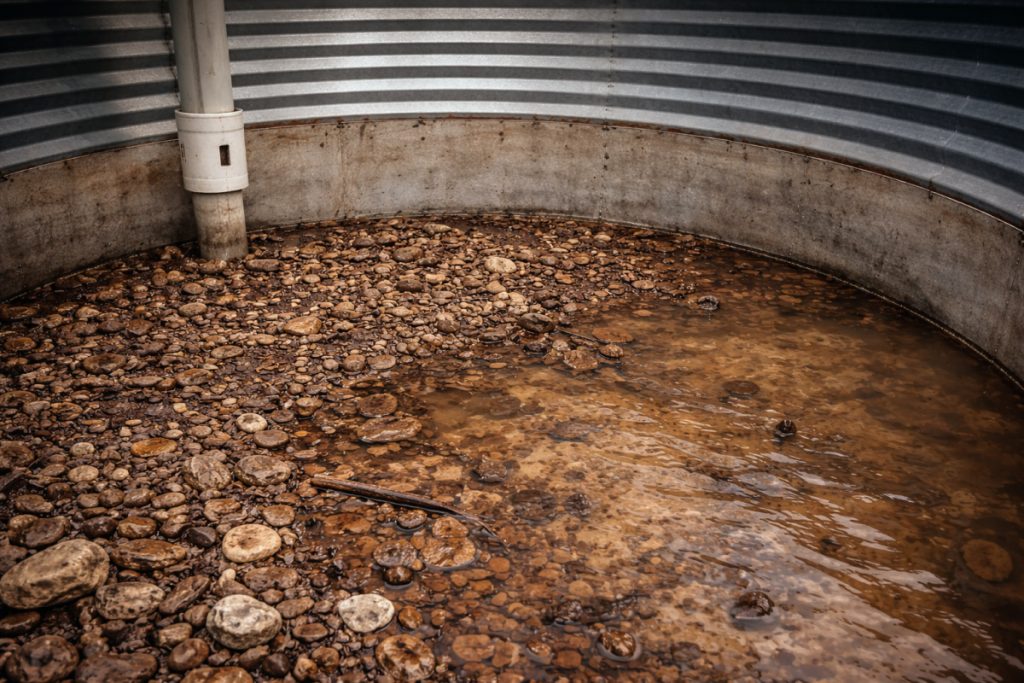
As sediment and debris build up, they occupy volume within the stormwater storage system. This reduces the space available for water storage, even though the system’s structural dimensions remain unchanged.
The reduction in effective storage capacity does not occur suddenly. Instead, performance gradually shifts as internal conditions evolve. This can lead to discrepancies between designed capacity and actual operating behaviour during storm events.
Why Accumulation Often Goes Unnoticed
One of the challenges with sediment accumulation is its lack of external indicators. Stormwater storage systems can continue to function without visible signs of change on the surface. Water may still flow in and out as expected, masking internal changes.
Because accumulation develops incrementally, its impact on system behaviour often becomes apparent only after extended periods or under high-demand conditions.
Understanding Internal Behaviour Over Time
Sediment and debris accumulation is a normal aspect of stormwater storage system behaviour. It reflects the interaction between runoff characteristics, flow dynamics, and internal geometry rather than structural failure or design flaws.
By understanding how and why accumulation occurs, engineers and asset managers gain clearer insight into long-term system performance and the factors that influence effective storage capacity over time.
