

Underground fire service tanks play an essential role in supplying reliable water reserves during emergency operations. Although these tanks are protected beneath the ground surface, they face unique engineering challenges that do not affect above-ground systems. One of the most critical considerations is underground tank anti floatation, a design requirement that prevents tanks from rising, shifting, or becoming structurally compromised due to buoyant forces.
Buoyancy becomes a major concern when groundwater levels rise or when the soil becomes saturated after storms, flooding, or seasonal changes. Because fire service tanks must remain stable and functional at all times, incorporating anti-floatation measures is fundamental to ensuring long-term system reliability.
1. Understanding Buoyancy in Underground Environments
Buoyancy occurs when water pressure beneath a structure becomes strong enough to lift it upward. This effect is similar to how objects float in water, except the force is exerted from groundwater pressing upward against the underside of a tank.
When the water table rises, the volume of displaced soil and water creates an upward force. If this force exceeds the weight of the tank and its contents, the tank can shift. Anti-floatation design ensures the weight and anchoring capacity remain greater than any upward hydrostatic pressure.
This principle is particularly important in fire service systems because underground tanks are often installed at depths where seasonal groundwater fluctuations are common.
2. Why Fire Service Tanks are Especially Vulnerable
Compared to other underground infrastructure, fire tanks face higher floatation risks because:
- they are typically large-volume structures
- they may remain partially empty between refill cycles
- they are placed in areas where soil moisture increases during rainfall
- the tank’s shape can create greater lift forces
- they must stay operational during extreme conditions
Even minimal tank uplift can cause misalignment, pipe strain, deformation, or compromised structural integrity.
Understanding underground tank anti floatation helps engineers ensure that fire service storage remains stable regardless of environmental conditions.
3. The Impact of Rising Groundwater Levels
Groundwater levels naturally fluctuate throughout the year due to:
- prolonged rainfall
- seasonal runoff
- nearby construction affecting drainage
- changes in soil compaction
- surrounding landscape modifications
If groundwater rises above the tank’s base elevation, hydrostatic pressure increases dramatically. Without anti-floatation engineering, this can result in:
- tank uplift
- cracking of surrounding concrete
- damage to inlet or outlet pipes
- distortion of internal components
In severe cases, a tank may shift upward several centimetres — enough to render the system unusable.
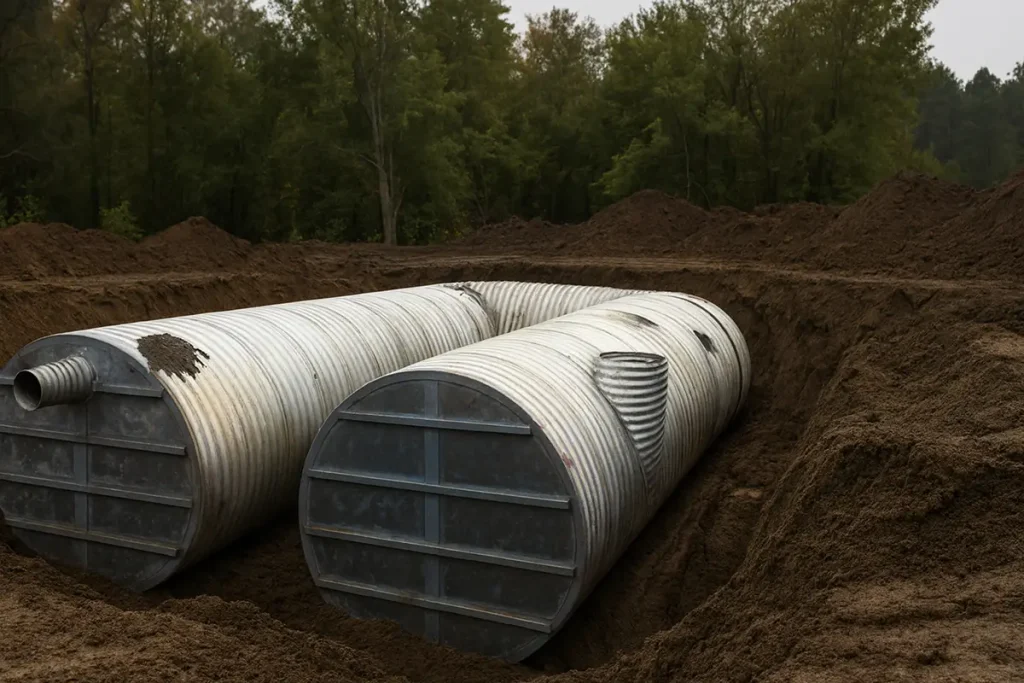
4. Partial Tank Emptying Increases Buoyancy
Fire service tanks are often not full year-round. During testing cycles or long periods without emergency demand, the tank may remain only partially filled. A tank with less internal weight becomes significantly more vulnerable to buoyancy.
This is why anti-floatation design is not optional; it ensures stability even when the tank holds minimal water.
5. Soil Saturation and Storm Events
Heavy rain can saturate soil with water faster than it can drain, increasing pore pressure and the risk of uplift. This is especially true in:
- clay-based soils
- low-lying installations
- areas with poor natural drainage
Stormwater accumulation effectively mimics high groundwater conditions, intensifying uplift forces. Anti-floatation measures provide a stable counterforce, keeping the tank fixed in position.
6. Structural Approaches to Anti-Floatation
Several engineering strategies help counter buoyancy forces:
Increased tank weight
Adding mass through reinforced structures or concrete encasement increases downward force.
Anchor beams or hold-down systems
Mechanical anchoring counters uplift by fastening the tank to surrounding foundations.
Concrete collars and slabs
These elements distribute tank load and create resistance against upward movement.
Soil backfill compaction
Properly compacted material improves lateral and vertical stability.
Drainage improvements
Redirecting groundwater reduces hydrostatic pressure around the tank.
Each method supports underground tank anti floatation by ensuring the tank’s downward force remains greater than any buoyant force.
7. Long-Term Risks of Ignoring Anti-Floatation
Failure to include anti-floatation measures can cause:
- structural shifts that compromise tank alignment
- cracks in external concrete
- pipe and valve misalignment
- gradual tank deformation
- higher maintenance and inspection requirements
- complete loss of tank function in severe cases
As fire service tanks must remain ready for use at all times, even minor displacement can undermine emergency preparedness.
8. Engineering Reliability for Fire Protection Systems
Because fire service water storage systems support high-risk operations, their structural reliability is non-negotiable. Anti-floatation design ensures:
- stability during extreme weather
- resistance to shifting groundwater
- predictable structural performance
- long-term integrity of fire delivery systems
Such principles are consistent with how advanced underground storage configurations are developed for critical safety applications.
Conclusion
Underground fire service tanks operate in dynamic soil and groundwater environments. Without proper anti-floatation design, these tanks are vulnerable to buoyancy forces that can compromise system reliability. Understanding underground tank anti floatation principles allows designers and operators to ensure that fire protection systems remain stable, functional, and ready for use in any conditions.
